PDA-LM Ink
Post-treatment-free liquid-metal ink via catechol–Ga³⁺ coordination — a 10-minute deep dive
I led this project end to end — ink chemistry, spray processing, electrical and surface characterisation, and the supporting DFT work.
TL;DR — Conventional liquid-metal (EGaIn) inks need mechanical sintering, organic solvents, or adhesion primers before they become useful conductors. A single chemistry — catechol–Ga³⁺ coordination — removes all three, by gating particle coalescence on fracture rather than on an added processing step. The result is a water-based, post-treatment-free ink that prints, sticks and conducts in one go.
- 🎯 The hook
- 🔍 Where this came from
- ⚠️ What everyone else tried
- 💡 Our pivot
- 🧪 What we built
- ✨ Novelty
- 🚀 What's next
-
Why should you care?
Imagine you want to print a soft, stretchable circuit directly onto human skin — for a wearable biosensor, a transient bioelectronic, or even a temporary tattoo display.
Today’s liquid metal (LM) inks force you to choose between:
- 🔥 Sinter it — mechanical pressure, laser, or stretch to break the oxide shell. Not gentle on skin.
- 🧴 Primer it — coat the substrate first with an adhesion promoter (often solvent-based, often toxic).
- 🌫️ Solvent it — disperse the LM particles in ethanol or worse. Slow drying, biocompatibility headaches.
We asked: what if a single chemistry could do all three jobs — particle-to-particle conduction, substrate adhesion, and water dispersibility — at once?
The answer turned out to be sitting in mussel biology.
-
The origin story
In late 2024 I was reading two literatures in parallel:
- Liquid metal printing papers — Qi, Pyeon, Lee, Zheng, Pei, Müller, Tian, and others. All elegant chemistry, all stuck on the sintering / primer problem.
- Mussel-inspired adhesion (PDA / DOPA) papers — Holten-Andersen’s foundational work on catechol–metal coordination, originally explaining how mussels glue themselves to wet rocks.
I noticed something both communities had stepped past without connecting:
EGaIn particles spontaneously grow a 2–3 nm amorphous Ga₂O₃ shell in air. That shell is what blocks conduction (so people grind it off) and what nobody bonds to (so people add primers).
But that shell is hydroxyl-rich amorphous oxide. And catechol’s signature trick is binding hydroxyl-rich metal-oxide surfaces.
If polydopamine could grip Ga³⁺ the same way it grips Fe³⁺ on mussel adhesives, it might simultaneously bridge particles and stick to substrates — without ever needing to remove the oxide.
That was the hypothesis worth testing.
Why dopamine·HCl specifically (and not just any catechol)?
Most catechol-on-LM work uses tannic acid or DOPA polymerized in Tris buffer. Both have side reactions: tannic acid is a giant heterogeneous polyphenol, and Tris itself coordinates Ga³⁺. We use **dopamine hydrochloride** at controlled pH to get clean catechol–Ga³⁺ binding without buffer interference — the Holten-Andersen UV-Vis fingerprints (mono/bis/tris stoichiometries with pH 5/7.5/10 transitions) come out cleanly. -
The graveyard of partial solutions
Eight key LM-ink papers, three failure modes:
Approach Group / year Solves conduction? Solves adhesion? Substrate-agnostic? Mechanical sintering Dickey et al. ✅ (after sintering) ❌ ❌ Laser sintering Various ✅ (after sintering) ❌ ❌ Sub-µm milling + solvent ink Qi 2022 ✅ ❌ partial Polymer primer underlayer Pyeon 2023 ✅ ✅ (primer-dependent) ❌ Magnetic field percolation Kim 2026 ✅ (in-field) ❌ requires AMF PDA-LM (this work) 2026 ✅ (instant) ✅ (catechol) ✅ (water-based) The pattern: every prior approach trades off one problem for another. Nobody hit all three boxes with a single ink.
The deeper reason: most groups treated the Ga₂O₃ shell as a problem to remove. We treated it as a binding site to exploit.
-
The framing, in one phrase
Fracture-gated coalescence. Two EGaIn particles can only merge where the oxide shell between them has broken. What the catechol chemistry changes is what happens in the instant after that break: the freshly exposed gallium is capped by coordination instead of immediately regrowing an oxide, so the fracture becomes a conductive junction rather than a new barrier. Coalescence is gated by fracture, not driven by an added sintering step — which is what makes the process post-treatment-free.
This is the framing I am presenting at the 2026 MRS Fall Meeting (Symposium SB13, 30 November 2026).
The chemistry, in one paragraph
Polydopamine’s catechol groups chelate the Ga³⁺ surface sites of the amorphous Ga₂O₃ shell. This achieves two things simultaneously:
- Particle–particle bridging → PDA chains link adjacent EGaIn particles through shared Ga³⁺ coordination → conductive network forms as the water evaporates, no sintering needed.
- Particle–substrate adhesion → PDA’s residual catechols (and pyrogallol-like oxidation products) bind hydroxyl-rich surfaces (PDMS, PVA, paper, skin) through the same Holten-Andersen mechanism.
The pH controls coordination stoichiometry (mono / bis / tris), which we tune to balance conductivity vs. adhesion.
Wait — does PDA itself short the conductive path?
Good catch. PDA is a semiconductor (~10⁻⁵ S/cm). Bulk PDA between particles would kill conductivity. But the catechol–Ga³⁺ coordination is **interfacial**, not bulk — PDA wraps the particle surface in a monolayer-thin shell. Particle-to-particle electron transport goes through the **Ga-O-PDA-O-Ga bridge** directly, not through bulk PDA. Empirically, we measure sheet resistances comparable to sintered EGaIn films.How do we know it's coordination and not just physisorption?
Three orthogonal evidence streams: 1. **UV-Vis titration** — pH-dependent absorption shifts matching Holten-Andersen's catechol–Ga³⁺ signatures (charge-transfer bands at ~395/495/600 nm depending on stoichiometry). 2. **ITC** — measurable binding enthalpy with stoichiometric breakpoint at the expected catechol:Ga³⁺ ratio. 3. **DFT (ORCA r2SCAN-3c, wB97X-D3/TZVP with BSSE)** — modeled catechol on -OH-terminated amorphous Ga₂O₃ slabs, binding energy ≫ physisorption baseline. -
The ink, the film, the demo
The ink
- Composition: EGaIn microparticles + dopamine·HCl + water (with pH adjuster)
- Storage: stable for weeks at 4 °C
- Patterning: screen-print, brush, spray, hydroprint — your choice
The film
- Conductive immediately after water evaporation (no post-treatment)
- Sheet resistance comparable to sintered EGaIn films
- Bonds to PDMS, PVA, paper, glass, and skin without primer
The demonstrator
- 4-LED circuit water-transferred onto skin (see Water-Transfer Electronics)
- Conductivity verified by lighting the LEDs immediately after transfer
- No sintering step, no primer step, no organic solvent
What the measurements show
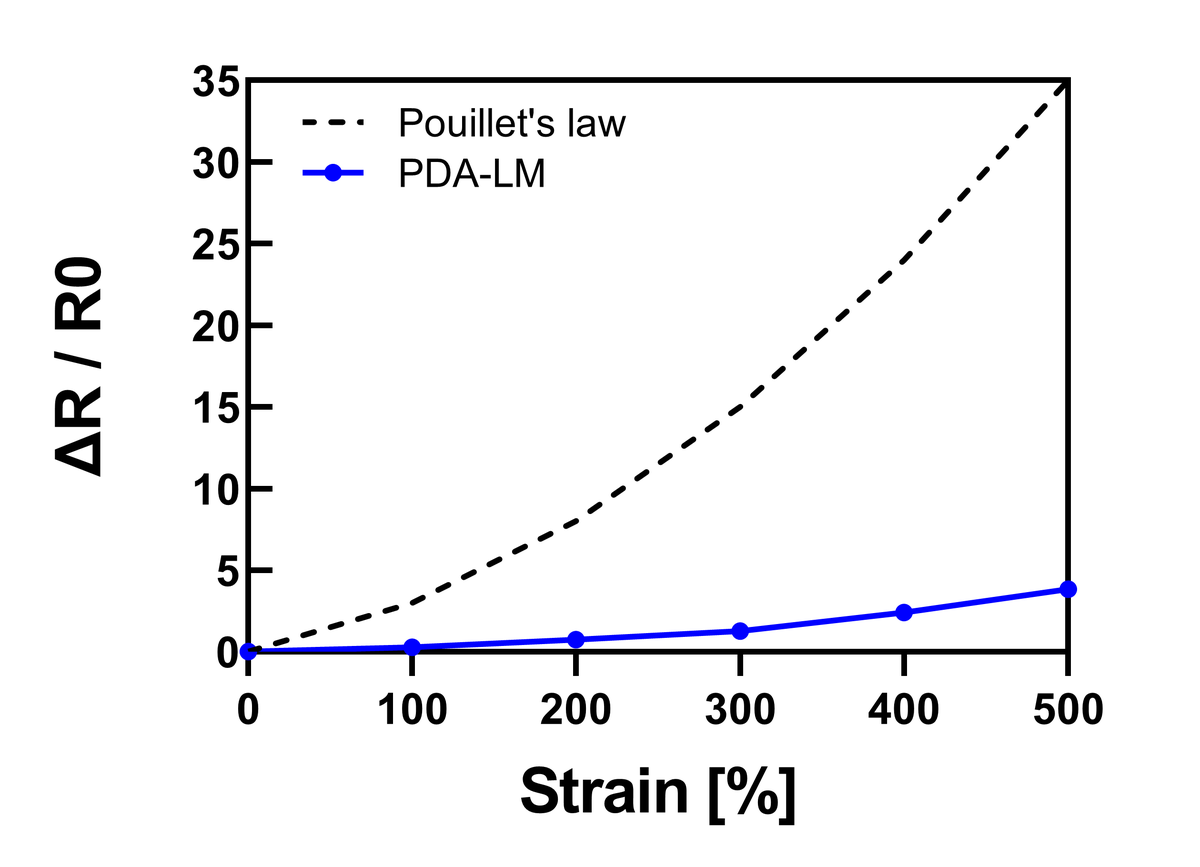
Resistance change under uniaxial strain. The dashed line is Pouillet's law — what pure geometry predicts for an incompressible conductor being stretched. The printed PDA-LM trace stays far below it out to 500 % strain, so geometry alone does not explain the response. 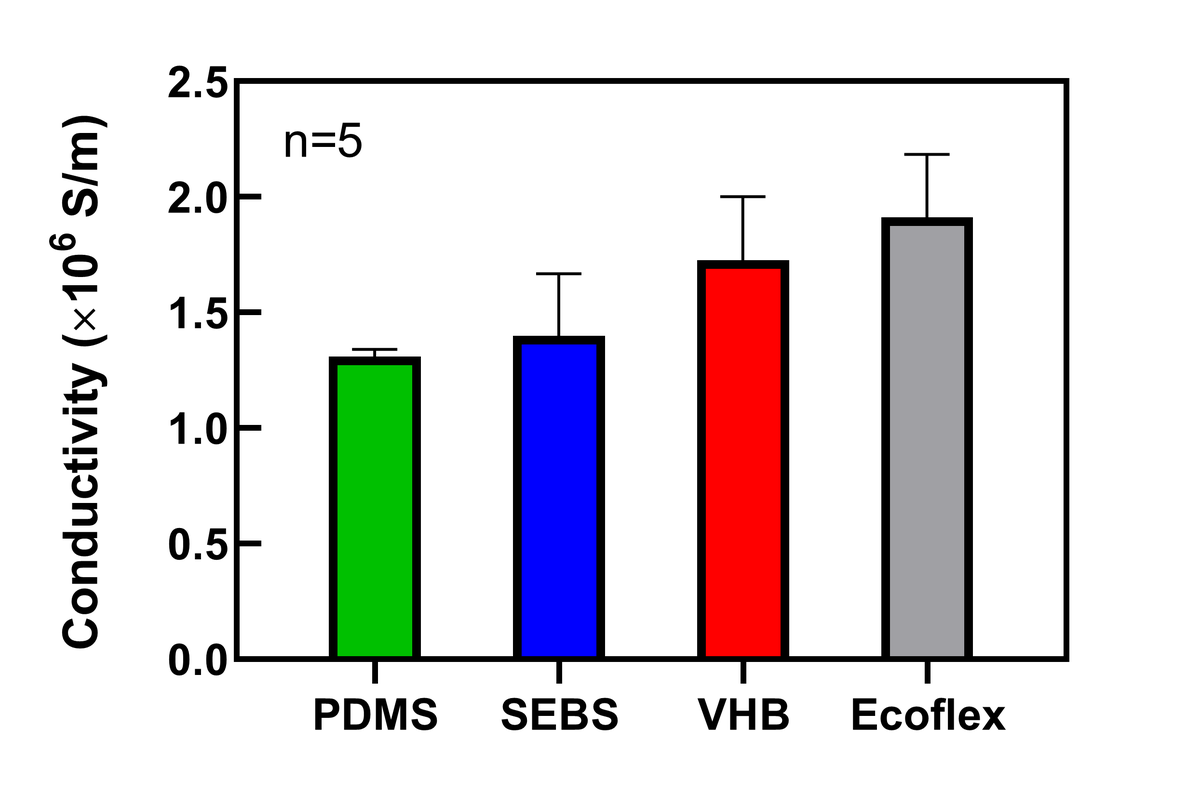
Conductivity of films printed on four different elastomers, n = 5 each. All four land within the same order of magnitude without a substrate-specific primer step. 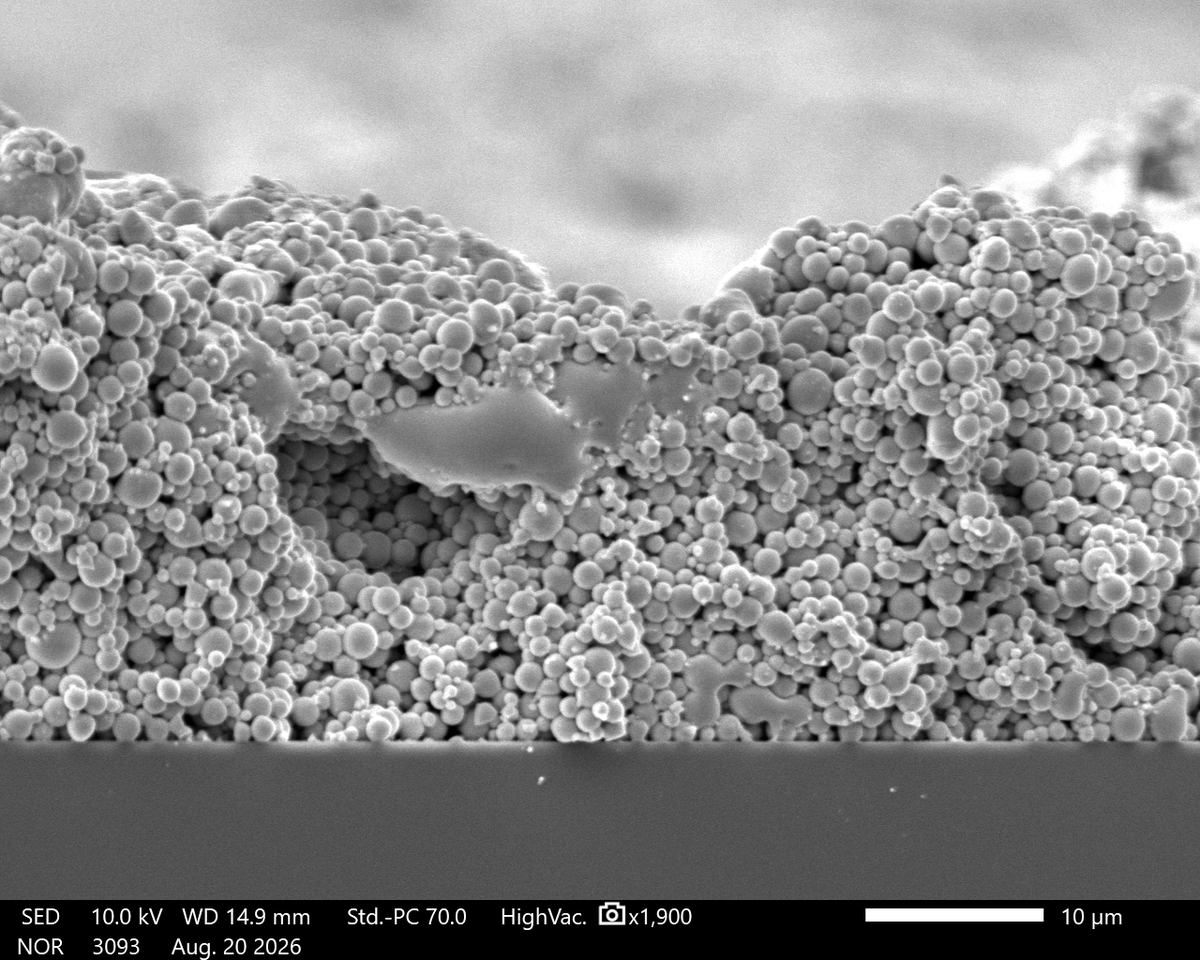
Cross-sectional SEM of a printed film. The particle layer sits directly on the elastomer surface; scale bar and imaging conditions are burned into the micrograph. The evidence stack (for the manuscript)
- 📊 UV-Vis — pH-stoichiometry titration matching Holten-Andersen framework
- 🌡️ ITC — binding enthalpy + stoichiometry breakpoint
- 🔬 XPS — Ga 3d / N 1s correlation on cured films
- 🧮 DFT — catechol–Ga₂O₃ surface binding energy from ORCA r2SCAN-3c (with BSSE)
- ⚡ 4-probe sheet resistance — quantitative conductivity vs. PDA loading
- 🤲 Pull-off / peel tests — adhesion vs. substrate
-
What’s new (in three claims)
We make three “first-time” claims, each backed by a different experiment:
Claim 1 — A liquid metal ink that requires no sintering, no primer, and no organic solvent. Evidence: 4-probe sheet resistance immediately after water evaporation, compared to all eight competitor inks in the table above.
Claim 2 — The same single chemistry (catechol–Ga³⁺ coordination) provides both particle-bridging and substrate adhesion. Evidence: removing dopamine eliminates both conductivity and adhesion (one-knob ablation); ITC + UV-Vis + DFT triangulate the coordination chemistry.
Claim 3 — The ink is biocompatible enough for direct on-skin printing. Evidence: 4-LED demonstrator on human skin, no irritation observed; water-based formulation with biologically-derived dopamine (already a clinical molecule).
Why this matters beyond our group
Anyone building wearable bioelectronics, transient electronics, or printable functional materials has been waiting for an LM ink that just works on soft, biological substrates. PDA-LM removes the sintering / primer / solvent overhead, making LM printing accessible to labs that don’t have laser sintering rigs or chemistry hoods optimized for organic solvents.
-
Roadmap
- ✍️ Manuscript drafting — mechanism figure, four results figures, and SI in progress
- 🤲 Water-transfer electronics platform — Phase 2 integrating AD5941 + BLE for self-contained skin-mounted biosensing
- 🧬 Wearable BCI — using PDA-LM microneedle contacts for ear-EEG
- 🔬 Chemistry extensions — substituting dopamine with other catechol-rich biomolecules (DHCA, gallic acid) to tune mechanical / optical / degradation properties
Want to collaborate?
If you work on:
- Transient / bioresorbable bioelectronics
- Skin-mounted continuous monitoring
- Printed flexible energy storage
…the PDA-LM ink might fit your stack. Get in touch.


Acknowledgments
This work is conducted in the BLISS Lab (Prof. Jungmok Seo) at Yonsei University, with computational support from the lab’s ORCA / Slurm cluster. DFT methodology builds on the lab’s prior amorphous Ga₂O₃ surface chemistry studies.